Leining (also spelled laining) is the traditional chanting of the Torah reading with its trop. In English it’s called Cantillation.
Preparing for a Bar Mitzvah?
Most people who learn to lein the Torah start the same way: a Bar Mitzvah boy with a parsha or haftara to prepare, a year — or less — to get it right, and a tune that has to come out in shul the way it did in practice. TorahSages was built for exactly that.
Your son hears every pasuk leined by a professional Baal Koreh, watches the words light up as they’re read, and repeats — phrase by phrase, aliyah by aliyah, at his own pace, on any phone, tablet, or computer. The trop is on the screen, the pronunciation is in his ears, and any phrase can be replayed until it clicks.
It works beautifully alongside a Bar Mitzvah teacher, too — the practice between lessons is where the parsha really gets learned. Start with the maftir and haftarah, or take on the whole parsha. The first aliyah of every parsha is free, and free membership opens every recording.
Leining practice, on one screen
Learn to lein — the words, the trop, and with proper pronunciation.
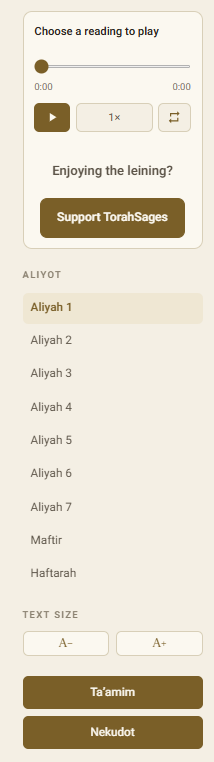
A tikkun gives you the marks but no sound. A recording gives you the sound, but you lose your place. TorahSages puts the fully pointed text and a clear recording side by side — the words light up as they’re leined.
Text that renders the trop right
Fully pointed nikud and ta’amim in a Hebrew font chosen to draw the marks cleanly on a phone — not the mangled half-marks most sites serve.
Recordings by master baalei kriah
Recorded by master baalei kriah who have taught Bar Mitzvah students for many years — clear, standard Ashkenaz trop, mastered to consistent volume across every aliyah, so nothing jumps out at you mid-practice.
Practice at your pace
Slow the playback when a phrase is tricky; bring it back to speed when it clicks. The player stays put while the Hebrew scrolls.
Help keep TorahSages free.
TorahSages is free to use, but it’s very costly to maintain. If you find it useful, can you please help cover the production and server costs?
How it works
Open your parsha. Pick it from the readings index, or jump to this week’s parsha from the homepage.
Follow the text as it plays. The words light up as they’re leined — on your phone, on the way to shul.
Repeat until it clicks. Read a little, hear it, repeat it, move on.
How long does it take to learn a parsha?
It depends far more on Hebrew reading fluency than on musical ability. As a rough guide: a boy who reads Hebrew comfortably needs roughly six months to a year for a full parsha, working at least a few times a week. Maftir and haftarah alone — what many shuls ask of a Bar Mitzvah boy — is a smaller undertaking, usually two to three months at the same pace.
The safest plan is to start earlier than feels necessary. Learning slowly, with time to forget and relearn, produces a reading that holds up in shul; cramming produces one that survives only in the living room. If you do not know which parsha yet, the Bar Mitzvah Calculator will tell you from the birthday.
By the time your Bar Mitzvah day rolls up, you’ll want to be very comfortable with the process.
A practice routine that works
The same loop works for a single pasuk or a whole aliyah. Keep the sessions short and frequent rather than long and rare.
- Listen first, without reading. Play the aliyah through once and just hear the shape of it — where the phrases rise, where they come to rest.
- Take one phrase at a time. Play a phrase, and then an entire verse (pasuke). Follow the highlighted words, then say it back immediately while the sound is still in your ear.
- Slow it down where it fights you. Reduce the playback speed for a difficult phrase and bring it back up once it settles — the trop is easier to hear when the notes are given room. Speed it up when you think you got it.
- Read it cold. Before you finish for the day, read the phrase once without playing it first. Using the leining tools next to the play button, turn off the nekudot and taamim (musical notes), and practice as if you are reading from the Torah klaff (scroll). What you can produce cold is what you actually know.
- Rinse and Repeat – Tomorrow! Re-read yesterday’s phrases before starting new ones. See how far you can go without nekudot and taamim. The review is where the parsha is really learned. Rinse and repeat, every day until you feel comfortable with the material!
Start with the maftir and haftarah
If the whole parsha is too much, this is the usual place to begin: the maftir is short, the haftarah has its own melody, and together they are a complete reading a boy can own. Some shuls lein the haftara from a klaf (scroll), so make sure you are aware of the rules of your own shul (synagogue). If you are reading from a klaf, you will also need to practice without nekudot and taamim, just like the parsha.
The brachot before and after the Torah reading and the brachot of the haftarah are recorded here as well — they are said aloud in front of the whole shul, and they are worth practicing as carefully as the reading itself.
What you are actually learning
A leining is three things at once, and they are best learned together rather than in sequence:
The words
Correct pronunciation and grammar (dikduk) — the vowels, the accented syllable, the difference a dagesh makes. This is the layer a mistake is most likely to change the meaning.
The trop
The ta’amei hamikra — the trop, or Hebrew cantillation: the melody, and at the same time the punctuation that tells you where each phrase ends.
The phrasing
Where to breathe, where to pause, how fast to move. The trop marks it for you; hearing an experienced Baal Koreh do it is how it becomes natural.
Questions people ask
Can a boy prepare without a teacher?
Some do, but most learn best with both: a teacher for correction and a recording for the hours in between. What is on this site is the practice half — the part that happens between lessons, which is where most of the learning actually takes place.
What if the parsha is a double one?
Some years join two parshiyot into one Shabbat. Each parsha is on the site as its own reading, so both are available — and the calculator will tell you whether a particular Bar Mitzvah Shabbat falls on a double.
Does it matter whether the Bar Mitzvah is in Israel or abroad?
It can. After certain festivals the two schedules fall out of step for several weeks, so the parsha of a given Shabbat may differ. The calculator asks where the Bar Mitzvah will take place and accounts for it.
Why not just use a tikkun?
A tikkun shows the letters as they appear in the Torah scroll, which is essential practice for reading without nikud and trop. It cannot tell you how anything sounds. The two work together: learn the sound here, then practise from the tikkun.
Free membership is live.
Stream every leining recording — every aliyah, maftir and megillah — with word-by-word highlighting as it’s leined. Joining takes under a minute: just your email, no password ever.
Built by a Professional Baal Koreh. Each of our ba’alei kriah have master level knowledge of grammar (dikduk), pronunciation, and decades of leining experience. TorahSages is both Torah and best of breed technology in one tool. Read the founder’s note →
New to the notes? What is trop — the full guide.
New to the notes? What is trop — the full guide.