Learn to Lein Parshat Vezot Haberachah Torah Reading וְזֹאת הַבְּרָכָה
Learn the Trop, Hebrew Cantillation
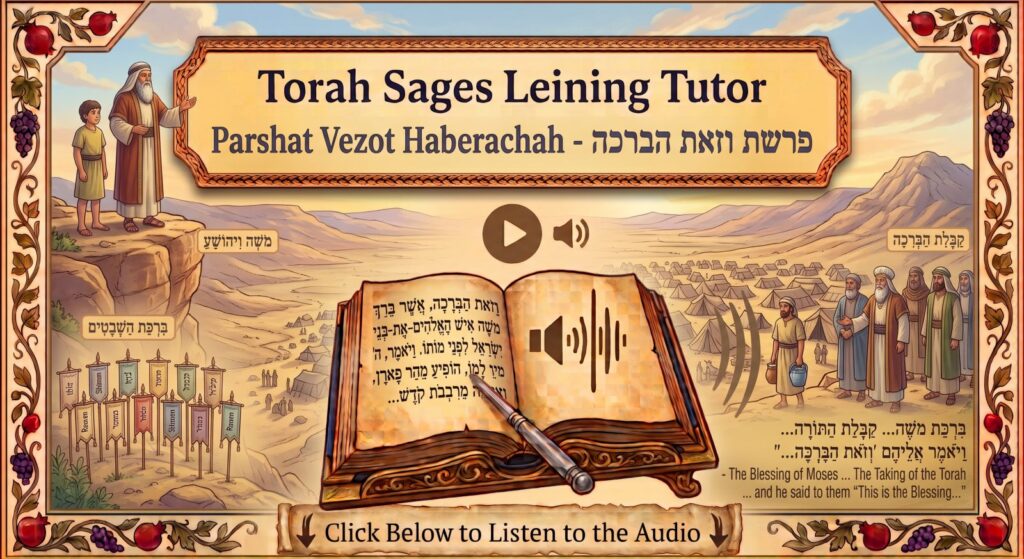
Parshat Vezot Haberachah is leined on Simchat Torah, not on a Shabbat: Moshe blesses each tribe before his death, and the Torah ends with Moshe going up Har Nevo, seeing the land, and dying at 120 with his eyes undimmed. On Simchat Torah the first five aliyot are repeated until every man has been called, then Chatan Torah reads the end and Chatan Bereishit begins again. About 7 minutes of leining, recorded aliyah by aliyah by a Master Baal Koreh with every word highlighted as it is read.
| Reading | Pesukim | Audio | |
|---|---|---|---|
| Aliyah 1 | Deuteronomy 33:1-33:77 pesukim | 1:00Free | Hear Aliyah 1 → |
| Aliyah 2 | Deuteronomy 33:8-33:125 pesukim | 0:54Members | Hear Aliyah 2 → |
| Aliyah 3 | Deuteronomy 33:13-33:175 pesukim | 0:46Members | Hear Aliyah 3 → |
| Aliyah 4 | Deuteronomy 33:18-33:214 pesukim | 0:37Members | Hear Aliyah 4 → |
| Aliyah 5 | Deuteronomy 33:22-33:265 pesukim | 0:36Members | Hear Aliyah 5 → |
| Aliyah 6 | Deuteronomy 33:27-33:293 pesukim | 0:40Members | Hear Aliyah 6 → |
| Aliyah 7 | Deuteronomy 34:1-34:1212 pesukim | 2:18Members | Hear Aliyah 7 → |
| Maftir | Deuteronomy 34:10-34:123 pesukim | 0:31Members | Hear the Maftir → |
| Haftarah | Joshua 1:1-1:1818 pesukim | Coming soon | Hear the Haftarah → |
Aliyah 1 — Deuteronomy 33:1-33:7
עלייה 1 — דברים 33:1-33:7This is the blessing: Hashem came from Sinai. Torah tzivah lanu Moshe, the first pasuk a child is taught. The blessings of Reuven and Yehudah.
Leining tip: Second pasuk - eishdat appears as one word in Torah parchment but read as two separate words. Eish (pause) dat. Fun fact: Vezot Haberacha is not read as a weekly Shabbat portion. It is read entirely on the holiday of Simchas Torah but in the Rosh Hashanah melody. The Monday and Thursday morning non holiday readings of Vezot Haberacha are read in the regular melody.
Aliyah 2 — Deuteronomy 33:8-33:12
עלייה 2 — דברים 33:8-33:12The blessing of Levi, the Urim and Tumim, teaching Torah to Israel and serving at the altar. The blessing of Binyamin, who dwells securely beside Hashem.
Aliyah 3 — Deuteronomy 33:13-33:17
עלייה 3 — דברים 33:13-33:17The blessing of Yosef: the choicest of the land, the firstborn ox, the tens of thousands of Efraim and the thousands of Menashe.
Back to top ↑Aliyah 4 — Deuteronomy 33:18-33:21
עלייה 4 — דברים 33:18-33:21The blessings of Zevulun and Yissachar, and of Gad.
Back to top ↑Aliyah 5 — Deuteronomy 33:22-33:26
עלייה 5 — דברים 33:22-33:26The blessings of Dan, Naftali and Asher, with iron and copper for his locks.
Back to top ↑Aliyah 6 — Deuteronomy 33:27-33:29
עלייה 6 — דברים 33:27-33:29There is none like the God of Yeshurun who rides the heavens. Happy are you, Israel, a people saved by Hashem. The end of the blessings.
Back to top ↑Aliyah 7 — Deuteronomy 34:1-34:12
עלייה 7 — דברים 34:1-34:12Moshe goes up Har Nevo and Hashem shows him the whole land. Moshe dies there at 120, his eye undimmed and his strength unabated, and no one knows his burial place. Israel mourns thirty days. There never arose a prophet like Moshe. The last pesukim of the Torah, leined by the Chatan Torah.
Back to top ↑Maftir — Deuteronomy 34:10-34:12
מפטיר — דברים 34:10-34:12On Simchat Torah the maftir is the mussaf of Shemini Atzeret from Parshat Pinchas, read from a second sefer Torah. In our recording the last three pesukim of the Torah are leined here: there never arose a prophet like Moshe.
Back to top ↑Haftarah — Joshua 1:1-1:18
הפטרה — יהושע 1:1-1:18After the death of Moshe, Hashem speaks to Yehoshua: be strong and courageous, this book of the Torah shall not leave your mouth. The first chapter of Neviim, leined as the Torah ends.